How the illusion works
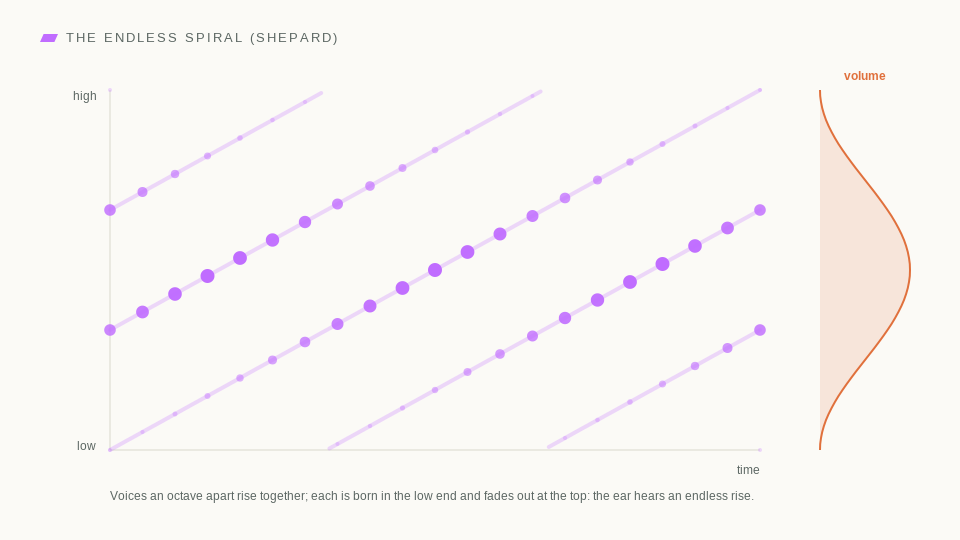
You play several notes an octave apart at the same time and make them all rise. When a voice reaches the top, it fades out; at the same moment, a new voice appears at the bottom. Because each voice’s volume follows a bell curve (quiet at the extremes, loud in the middle), you never hear a voice start or end: only the rise.
The settings that matter
| Setting | Starting value | Effect |
|---|---|---|
| Number of voices | 5 to 8 | fewer: the trick shows; more: a denser sound |
| Speed | one octave in 4 to 10 s | slow = dread; fast = urgency |
| Bell width | wide, centered in the mids | hides the hand-off between voices |
| Timbre | sine, strings, brass, filtered noise | from the “purest” to the most organic |
When to use it
- Suspense: a slow Shepard under a tense scene keeps the anticipation going without ever resolving it.
- The long end-of-trailer riser: 8 to 16 bars that climb without getting boring, before the last title.
- The endless descent: the same thing backwards, for a fall, vertigo, horror.
- Under the orchestra: quietly, below the strings, it adds tension without being identified.
Ending a riser that never ends
A Shepard never stops on its own: you have to cut it. The strongest cut is a clean 100 to 250 ms silence, then the impact. For the full riser-and-impact method, see creating a trailer riser and impact.
The endless spiral in Nebula
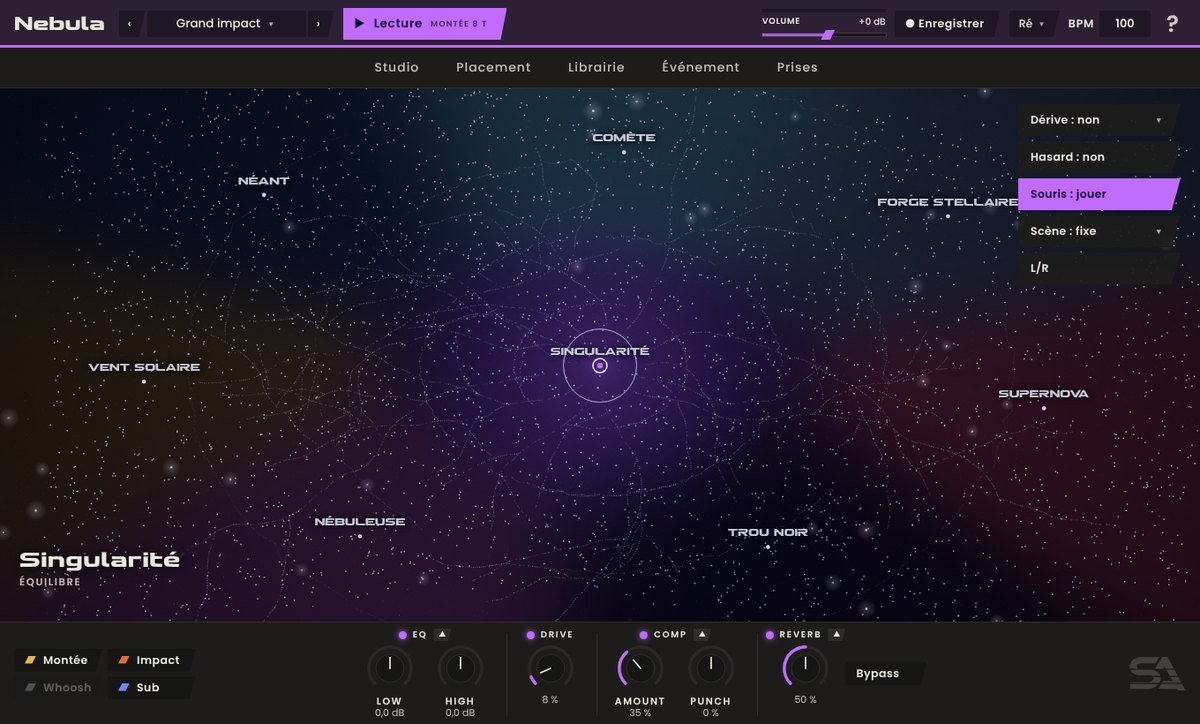
In synthesis, Nebula offers the Endless Spiral riser (an adjustable Shepard tone: its center is set as a note in the Event view); the bank also contains built Shepard risers. Like every riser, it ends on the impact: change the riser length in the Studio and it tightens or stretches without changing its ending. The Void place in the constellation brings spirals, glissandos and ship pass-bys forward.
| Setting | Value | Why |
|---|---|---|
| Layer | Rises › Endless Spiral | The Shepard illusion |
| Riser length | 4 to 8 bars | Long tension |
| Effect: LFO on Volume, Accel | high Accel | The pulse speeds up towards the impact |
| Place | towards Void | Spirals and glissandos up front |
| Silence before the impact | one eighth note | The cut that releases the tension |
Frequently asked questions
What is the Shepard tone?
An auditory illusion: voices an octave apart rise together, each appearing in the low end and fading out at the top. It feels like an endless rise.
Which films use a Shepard tone?
The technique is often mentioned in connection with Christopher Nolan’s suspense films, especially Dunkirk, where the music gives a feeling of tension that never drops.
How do I make a Shepard tone in a DAW?
Duplicate a pitch rise (glissando) on 5 to 8 tracks an octave apart, give each one a bell-shaped volume curve based on its pitch, and loop. A dedicated plugin does it more simply.
Can a Shepard tone go down?
Yes: the same construction in reverse gives an endless descent, useful for a fall or a scene of dread.
Updated on November 23, 2026.