The pitch curve
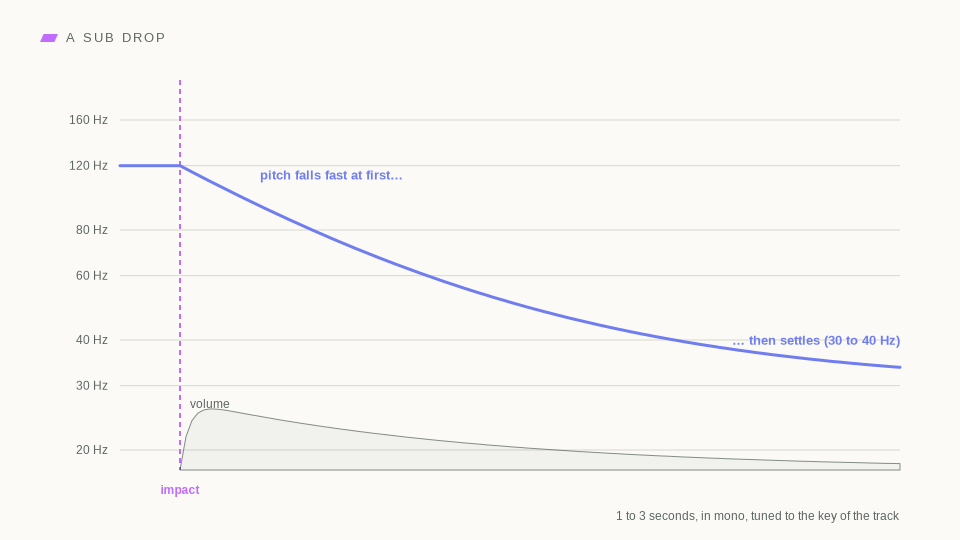
The whole character of a sub drop is in its curve. A linear drop sounds like a siren winding down; an exponential drop (fast at first, slow at the end) sounds like a blow that settles.
| Setting | Starting value | Effect |
|---|---|---|
| Start note | 80 to 120 Hz | the initial blow |
| End note | 30 to 40 Hz | the vibration, below the bass |
| Length of the fall | 0.5 to 2 s | short = hit; long = rumble |
| Attack | 5 to 15 ms | no click |
| Total length | 1 to 3 s | stops before the next hit |
Step 1: the source
A sine wave is enough. A little soft saturation adds harmonics that make the sub audible on small speakers (a phone can’t reproduce 40 Hz, but it reproduces 80 and 120 Hz, which the ear connects to the fundamental). A well-tuned 808 is also a sub drop.
Step 2: tune it to the key
A sub that’s out of the track’s key creates an unpleasant beating with the bass. Make the drop land on the root (or the fifth): in D, 36.7 Hz; in E, 41.2 Hz; in C, 32.7 Hz.
Step 3: the mix
- Mono: below 120 Hz, everything stays in the center.
- No reverb: reverb on a sub turns into mud.
- Headroom: a sub drop carries a huge amount of energy. Keep 3 to 6 dB in reserve on the master at that spot.
- Move the bass aside: during the drop, lower the music’s bass (or let it rest) so they don’t fight.
A sub drop in Nebula
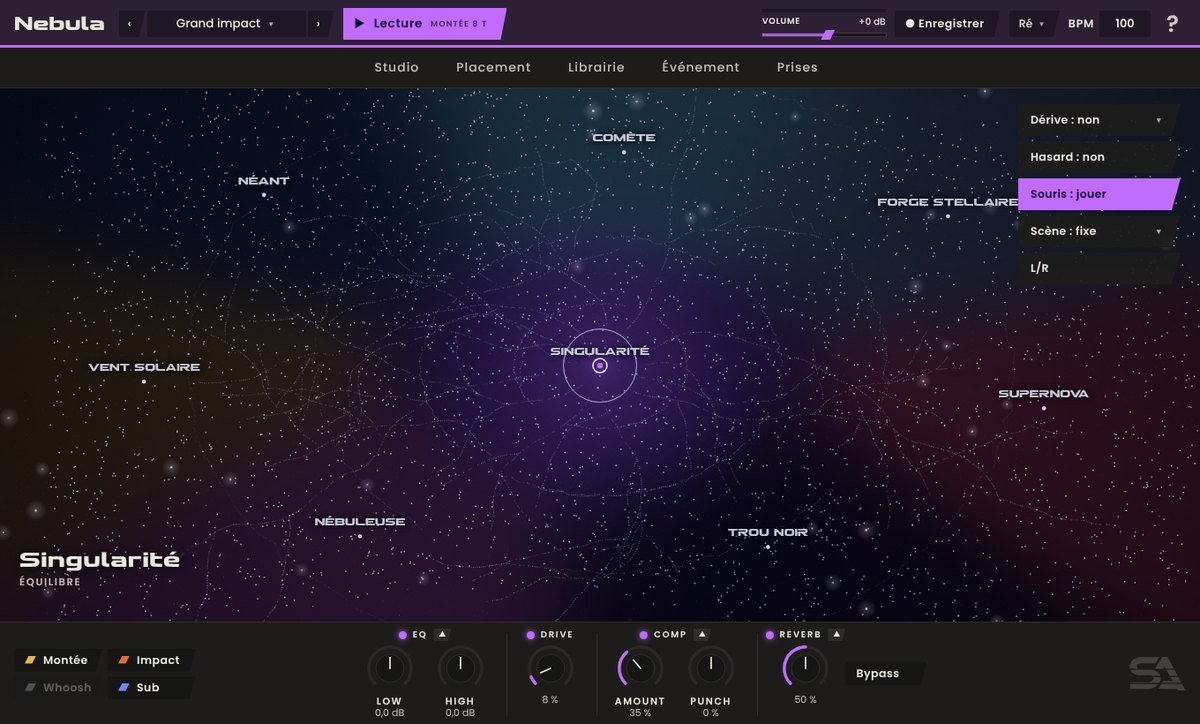
Add a layer from the Subs family, in synthesis (Falling sub) or from the bank (sub drops, sub risers). In synthesis, the Event view sets its start and end note (Start → End), as notes or in Hz; choose the track’s Key: subs, tuned booms and glissandos follow it. In the mix of any layer, the Sub setting adds a tuned sub hit under each attack, or removes the low end down to −24 dB.
| Setting | Value | Why |
|---|---|---|
| Layer | Subs › Falling sub | The pitch drop |
| Start → End | from 55 Hz (A) to 37 Hz (D) | Land on the root in D |
| Key | D | Every sub in the preset tuned |
| Place | towards Black Hole | More sub and rumble, less top end |
| Reverb | on the other layers only | The low end stays dry |
Frequently asked questions
What frequency should a sub drop be?
You usually start at 80 to 120 Hz and end between 30 and 40 Hz, on the root or the fifth of the track.
Why can’t I hear my sub drop on a phone?
Small speakers can’t reproduce below 80 to 100 Hz. Add soft saturation: the harmonics it creates let the ear “rebuild” the low end.
Should a sub drop be in stereo?
No. Below 120 Hz, keep everything in mono: in stereo, the sub can partly cancel out and its level changes with the listener’s position.
How do I avoid the click at the start of a sub drop?
Give it a 5 to 15 ms attack and start the sine at zero. The crack of the impact covers the very start anyway.
Updated on November 23, 2026.