
The anatomy of a movie explosion
What you hear as a single explosion is a very fast sequence of events. Recreating them one by one is the key to realism… and to size.
| Part | Length | What it is | Possible source |
|---|---|---|---|
| Shockwave | 5 to 50 ms | the crack, the air hitting | hand clap, whip, slammed door |
| Fireball | 0.3 to 1.5 s | the low body, the blast | slowed thud, breath into a mic |
| Rumble | 1 to 4 s | the sub, what you feel | low sine, slowed thunder |
| Debris | 0.2 to 3 s | what falls back, the material | gravel, glass, scrap metal, a bag of candy |
| Space | 2 to 6 s | echoes from the landscape | outdoor reverb, distant echoes |
Step 1: pick a short, percussive starting sound
The best starting point has a sharp attack and a bit of noise: a slammed car door, a hit on a cardboard box, a popping balloon, a book dropped flat, a kick drum. Avoid sustained or very tonal sounds: slowed down, they turn into notes, not explosions.
Step 2: pitch it down one or two octaves
This is the move that does everything. A sound slowed to −12 or −24 semitones becomes lower and longer: a 0.2 s door slam becomes a blast of almost a second. Prefer varispeed (pitch and length linked, like a slowed tape) over pitch-shifting that keeps the length: it gives a more natural, heavier grain.
| Transposition | Length | Effect |
|---|---|---|
| −7 semitones | × 1.5 | heavier, still recognizable |
| −12 semitones | × 2 | a medium explosion |
| −24 semitones | × 4 | a huge, distant explosion |
Step 3: saturate for violence
A real explosion overloads the mics. Solid saturation (overdrive, tape, soft distortion) on the slowed body adds harmonics, makes the sound audible on small speakers and gives it violence. Saturate in parallel: keep the clean sound and blend a heavily saturated copy underneath.
Step 4: add a rumble
Slowing down adds low end, rarely enough. Add a 30 to 50 Hz sub that starts with the body and decays over 1 to 4 seconds, with a slight pitch drop at the start. Keep it mono, and tune it if the explosion lands on music. The sub drop tutorial details its curve.
Step 5: let the debris fall
Debris tells you what exploded: glass for a shop window, scrap metal for a car, stone for a wall. Start it after the shockwave, between 100 and 800 ms, in several waves that get smaller and smaller, spread across the stereo field. Cut its lows below 200 to 300 Hz: debris lives in the mids and highs.
Step 6: put the explosion outside
An outdoor explosion doesn’t sound like it’s in a cathedral. It has no dense reverb, but echoes: the sound comes back from buildings and hills, delayed and without highs. Use an outdoor reverb or two or three distant echoes (150 to 600 ms, filtered above 3 kHz) rather than a big hall.
Step 7: assemble it and add contrast
- 1
Align the shockwave
Align the peaks of the shockwave, the body and the sub at the same instant.
- 2
Offset the debris
Offset the debris by 100 to 800 ms, in waves.
- 3
Add the space
Add the space to the body and the debris, starting at the impact.
- 4
Glue the group
Glue everything on a bus: slow compression (2 to 4 dB), a touch of saturation.
- 5
Set up the hit
Leave a short silence before the explosion, or a suck-in (reversed sound) that stops right on it.
An explosion in Nebula
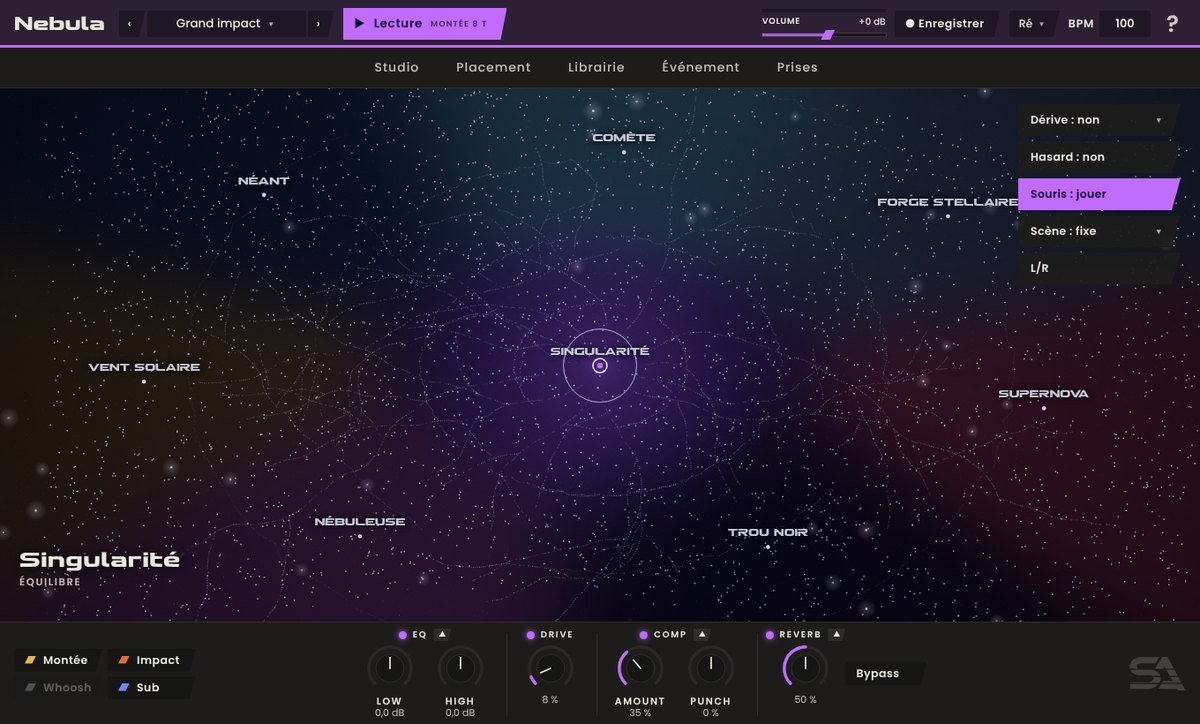
In Nebula, open the Event view: the Composite Impact offers the explosion material (as well as metal, wood, stone, glass…), its variant, then the attack, the body and the tail. Add a Sub from the Subs family (Boom, Falling sub, Rumble): it starts from the impact and follows the Key. Debris lives in the Impacts family. On the constellation, drag the point towards Black Hole for a darker, lower explosion. Your own starting sound can then be layered in your DAW: drag Nebula’s take next to it as a WAV.
For a distant explosion, lower the lead layer’s Impact and open the Reverb further; for a very close one, do the opposite.
| Setting | Value | Why |
|---|---|---|
| Composite Impact: material | explosion | The character of the hit |
| Sub | Subs › Rumble | Weight that lasts |
| Debris | Impacts › Debris | What falls back |
| Master, Drive | medium to high | Violence, small-speaker translation |
| Master, Comp: Punch | high | The shockwave up front |
| Master, Reverb: Tail | opens on the impact | The landscape after the hit |
Frequently asked questions
What are movie explosion sounds made from?
Rarely from real explosions. Short sounds (doors, hits, balloons, breaths) are slowed down and saturated, then a sub, debris and outdoor echoes are added.
How far should I pitch a sound down for an explosion?
One to two octaves (−12 to −24 semitones), with varispeed so the sound gets longer at the same time. The lower you go, the bigger and more distant the explosion sounds.
Should an explosion have reverb?
Outdoor echoes rather than hall reverb, and only on the body and the debris. The sub and the shockwave stay dry.
How do I make an explosion sound more realistic?
With debris that tells you what exploded (glass, metal, stone), offset by 100 to 800 ms after the shockwave, and a space that matches the location of the scene.
Updated on November 24, 2026.