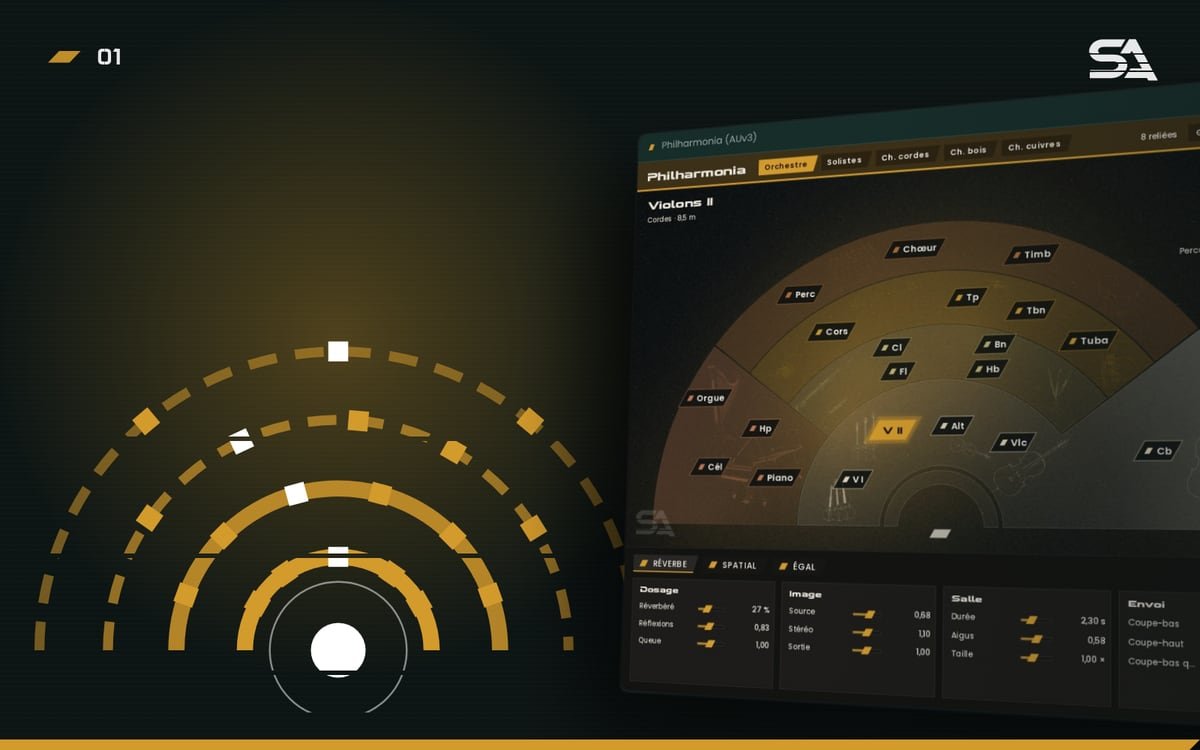
Placement matters more than panning
Panning does only one thing: it splits the level between the left and right speakers. In a real hall, a musician's place changes much more than that. It changes when their echoes off the walls arrive, how strong they are, which direction they come from. A cello on the right doesn't have the same Early reflections as a cello in the center.
That's why an orchestra placed with panning alone often sounds like musicians lined up in front of a wall. They're on the left or on the right, but not really somewhere. To go further, you also need to handle depth: that's the subject of the guide on adding depth to a sample library.
A symphony orchestra's layout, row by row
Seen from the audience, the most common layout today, often called American seating, looks like this:
- Front row, in front of the conductor: the strings. First violins on the left, second violins next to them, violas toward the center, cellos on the right.
- Behind the cellos: the double basses, on the right and slightly further back.
- In the middle: the woodwinds, in two rows. Flutes and oboes in front, clarinets and bassoons behind.
- Behind the woodwinds: the horns, often on the left.
- At the back: trumpets, trombones and tuba, rather center-right.
- All the way at the back: timpani and percussion. The harp and keyboards often sit on the left side.
There's a variant, often called German or old-style seating: the second violins move to the right, facing the first violins, with the cellos and violas in the center and the double basses behind on the left. It highlights the dialogues between first and second violins, very common in Mozart or Beethoven. Choose one or the other depending on the music, but stay consistent throughout the piece.
In what order should you place the families?
- 1
Strings first
They form the foundation and play almost all the time. Place first violins, second violins, violas and cellos in the front row, with moderate panning.
- 2
The basses
Double basses behind the cellos. Their low end isn't easy to locate, so don't send them hard right: a little to the right is enough.
- 3
The woodwinds
In the center, behind the strings. They often play solo lines: keep a narrow image for each one.
- 4
The brass
Horns behind the woodwinds, then trumpets, trombones and tuba at the back. They're powerful: it's their distance that puts them in their place, not their fader.
- 5
Percussion and keyboards
Timpani and percussion all the way at the back. Harp, piano and celesta to the side.
- 6
Soloists last
A soloist stands in front of the orchestra, near the conductor. Place them once everything else is in place, to judge whether they stand out.
Panning: how wide should you go?
An orchestra is recorded with a main mic pair, above the conductor. That pair hears every musician in both speakers, with a little more on one side than the other. Result: on a recording, even the first violins are never fully on the left.
So keep panning moderate. The further away a section is, the closer it gets to the center of the image, because the angle you see it from gets narrower. Front-row sections can go further toward the sides. For wide sources, like a string section, work on width rather than extreme panning.
| Section | Distance from conductor | Side | Starting pan |
|---|---|---|---|
| First violins | 5.5 m | Left | -50 |
| Second violins | 5.5 m | Left | -30 |
| Violas | 5.5 m | Center | +10 |
| Cellos | 5.5 m | Right | +30 |
| Double basses | 7.5 m | Right | +42 |
| Flutes / Oboes | 9.5 m | Center | -16 / +16 |
| Clarinets / Bassoons | 11.5 m | Center | -22 / +22 |
| Horns | 11 m | Left | -34 |
| Trumpets | 13.5 m | Center right | +24 |
| Trombones / Tuba | 14 m | Right | +38 / +44 |
| Timpani | 14.5 m | Back | +28 |
Left and right are always seen from the audience. These numbers are starting points that are consistent with each other. If you move a section, keep the logic: what is far away narrows, what is up front can open up.
Soloists, choir and small ensembles
The soloist
A concerto puts the soloist in front of the orchestra, next to the conductor. They're therefore closer than everyone else, with a narrow image and little room. Don't put them exactly in the center if an important section is already playing there: a slight offset is enough to separate them. A solo singer, on the other hand, is usually right in the middle.
The choir
A choir stands at the back, behind the orchestra, across the whole width. It's a wide but distant source: lots of room, an open image, soft attacks. If you bring it too close, it moves in front of the strings and the picture stops making sense.
Quartets and chamber music
For a small ensemble, everything tightens up. The musicians sit in an arc, a few meters from each other, and the listener hears them from closer. Panning stays moderate, the room is smaller and shorter. The guide on choosing the hall for a virtual orchestra helps you find the venue that fits.
This interactive tool needs JavaScript.
With Philharmonia: place, drag, listen
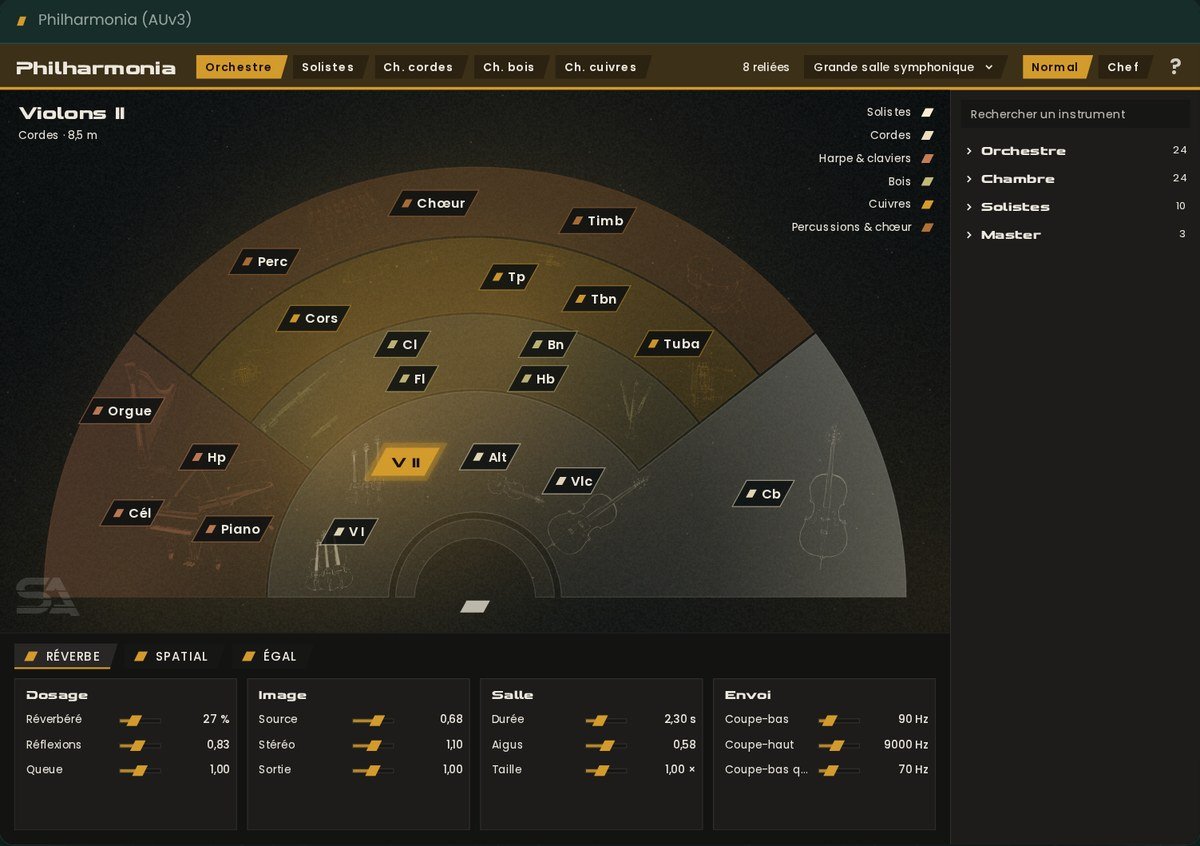
Philharmonia is built around this plan. Each section sits in its real place, in meters around the conductor, and the place decides the Early reflections, and so the depth. Here's how to use it.
- 1
Choose the ensemble
At the top of the plan, choose Orchestra, Soloists, or one of the three chamber ensembles: strings (quartet, trio, baroque ensemble), woodwinds (wind quintet, reed trio) or brass (brass quintet). The plan shows only one at a time.
- 2
Choose the section
Click its tag on the plan, or its line in the list. Tuttis and ensembles set a whole family in one go. You can also type a few letters in the search box.
- 3
Drag the tag
The yellow tag is the instrument you're setting. Drag it: its position, pan, wet amount and Early reflections follow the distance. Further away, it moves back in the hall; to the side, it moves left or right.
- 4
Take over the pan by hand
In the Spatial module, the pan of the direct sound follows the place on the plan, but you can take it over. That's a mixing decision, separate from the place on the stage.
- 5
Set the spread
The Spread setting tells how far the place pushes the pan. At zero, moving a section no longer moves the stereo image, but the echoes still follow the place.
Guidelines taken from Philharmonia's default places and a standard orchestra layout. Adapt them to your writing.
| Front row | Strings, about 5.5 m from the conductor | The foundation of the orchestra, closest in. |
|---|---|---|
| Middle rows | Woodwinds, 9.5 to 11.5 m | Behind the strings, in the center. |
| Back of the stage | Brass and percussion, 11 to 14.5 m | Their power is kept in check by distance. |
| Soloists | In front of the orchestra, near the conductor | They should stand out without raising the fader. |
| Panning | Moderate, never hard | The main pair hears everyone on both sides. |
Once everyone is placed, move on to dosing with the Reverb settings for orchestra, then go back to the pillar guide on mixing an orchestra to balance the families.
Frequently asked questions
Where should first and second violins go in the mix?
In the most common layout, the first violins are on the left and the second violins right next to them, a little more toward the center. In German seating, the second violins move to the right, facing the first violins. In both cases, keep panning moderate.
Should the double basses go on the right?
In the most common layout, yes, behind the cellos. But low end is hard to locate, so there's no point pushing them to the extreme: a little to the right is enough and keeps the bottom of the mix balanced.
Why does my orchestra sound too wide?
Often because the pans are pushed all the way and every source is widened a lot. A real orchestra is captured by a main pair that hears each musician on both sides. Narrow the sections at the back and keep the width for the front-row sections.
In what order should you place an orchestra's instruments?
Strings first, then the basses, woodwinds, brass, percussion and keyboards. Soloists come last. Listen to the tutti after each family to keep the balance.
Is panning enough to place an instrument?
It's enough for left and right, not for depth. The real place also changes the Early reflections, the ratio between direct sound and room, and the color. Without those cues, the instrument is on the left or the right, but always on the same plane.
Updated on October 30, 2026.