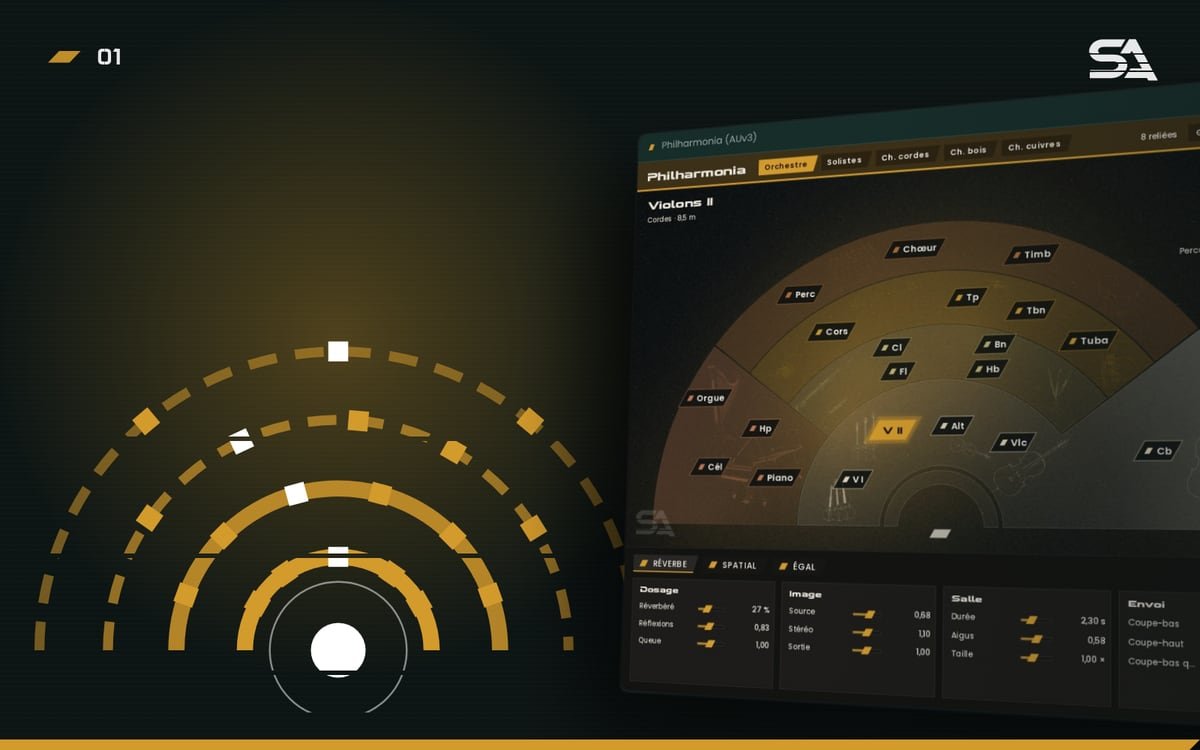
The principle: the softest in front, the loudest at the back
Orchestra seating follows a simple acoustic logic: the most numerous and least powerful instruments (the strings) are in front, the most powerful (brass, percussion) at the back. That way, the conductor and the audience hear a natural balance, without anyone forcing.
| Row | Sections | Distance from the conductor |
|---|---|---|
| Front row | violins I, violins II, violas, cellos | 2 to 6 m |
| Behind the strings | double basses (cello side) | 6 to 9 m |
| Center | flutes, oboes, clarinets, bassoons | 7 to 10 m |
| Back | horns, trumpets, trombones, tuba | 10 to 14 m |
| Far back | timpani, percussion, harp and keyboards on one side | 12 to 16 m |
American or German seating
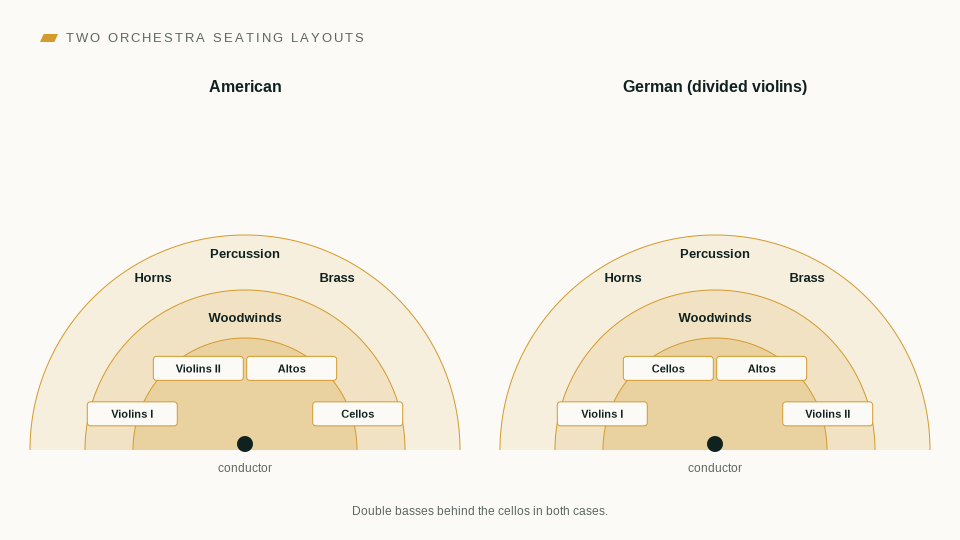
- American seating (the most common today, popularized by Leopold Stokowski): from left to right, violins I, violins II, violas, cellos, double basses behind the cellos. The violins sound like one block, the low end is on the right.
- German seating, or divided violins (the layout of Beethoven’s, Brahms’s and Mahler’s time): violins I on the left, violins II on the right, facing each other; cellos and violas in the center. The dialogue between first and second violins is heard on each side.
Reproducing the layout in the mix
Panning isn’t enough. A section at the back isn’t just “in the center”: it’s farther away, so weaker in the top end, with more room and early reflections arriving sooner relative to the direct sound. Without that depth, the whole orchestra seems to be playing in the front row. The tutorial placing instruments on a virtual stage details these settings.
- 1
Moderate panning
An orchestra heard from the conductor’s podium isn’t spread 100% wide. Stay between 50 and 70% for the outermost sections.
- 2
Distance
More room, less top end and a little less level for the back rows.
- 3
The same hall for everyone
Every family must seem to play in the same place: a single shared reverb, set differently depending on distance.
With Philharmonia
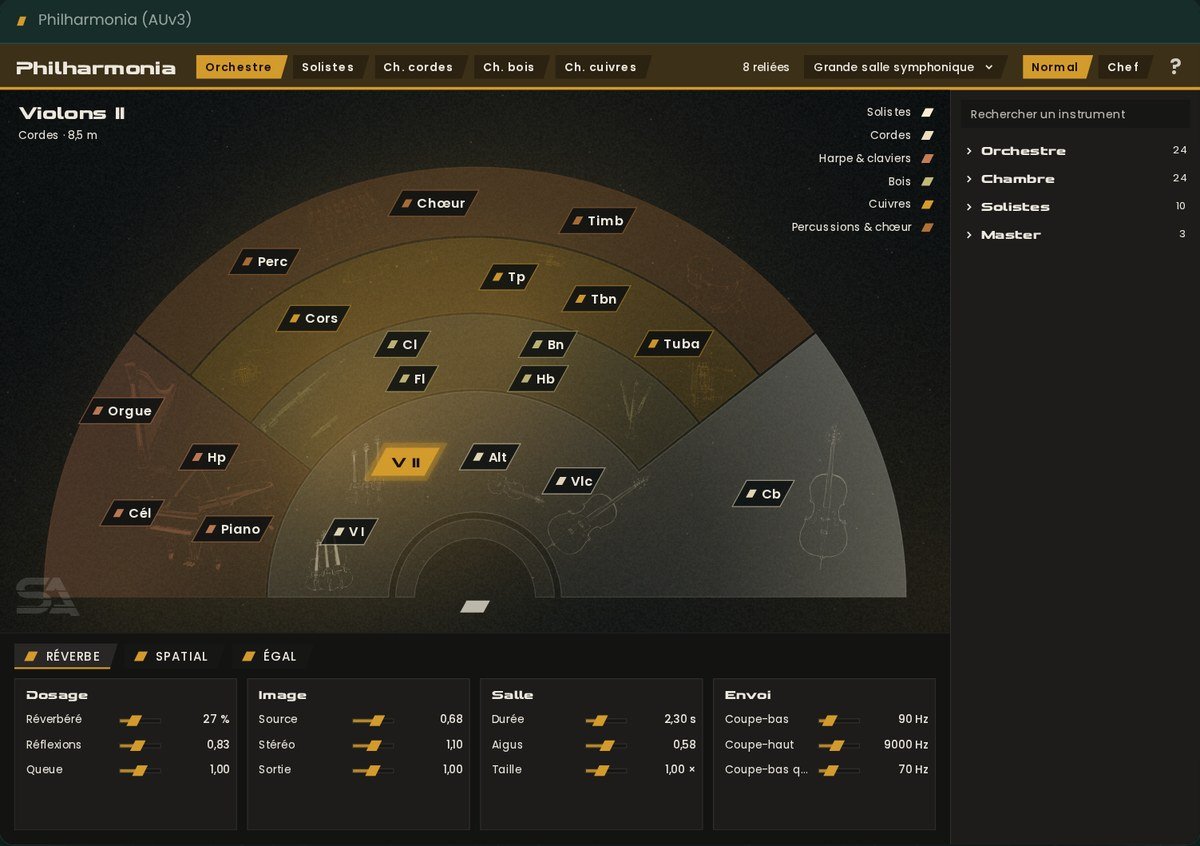
Philharmonia starts from the stage plan. Each instance is a section placed in meters around the conductor: move it, and the pan, Early reflections, Reverb and distance EQ follow. For German seating, simply move the violins II to the conductor’s right. In Conductor mode, every instance in the project appears on the same plan.
Frequently asked questions
What is the standard seating of a symphony orchestra?
Strings in front in an arc around the conductor, woodwinds in the center, brass behind, percussion and timpani at the back. American seating puts violins I and II side by side on the left, cellos on the right.
Why are the violins on the left?
So their f-holes and instruments face the audience, and by tradition since the 20th century. In German seating, violins II are on the right, facing the firsts.
Where should I place the horns in a virtual orchestra?
At the back, usually on the left or in the center, behind the woodwinds. Because their bells face backwards, their sound is indirect: a little more room suits them.
Should the mix follow the real seating?
It’s the safest starting point for a natural sound. For film music or an epic style, you can depart from it (closer brass, wider percussion), while keeping a shared room.
Updated on November 23, 2026.