The real power of the families
Sample libraries erase an acoustic reality: instruments don't have the same power at all. A trombone at forte easily covers a whole violin section; a flute in its low register disappears under two violas. Keeping these ratios in mind is the basis of balance.
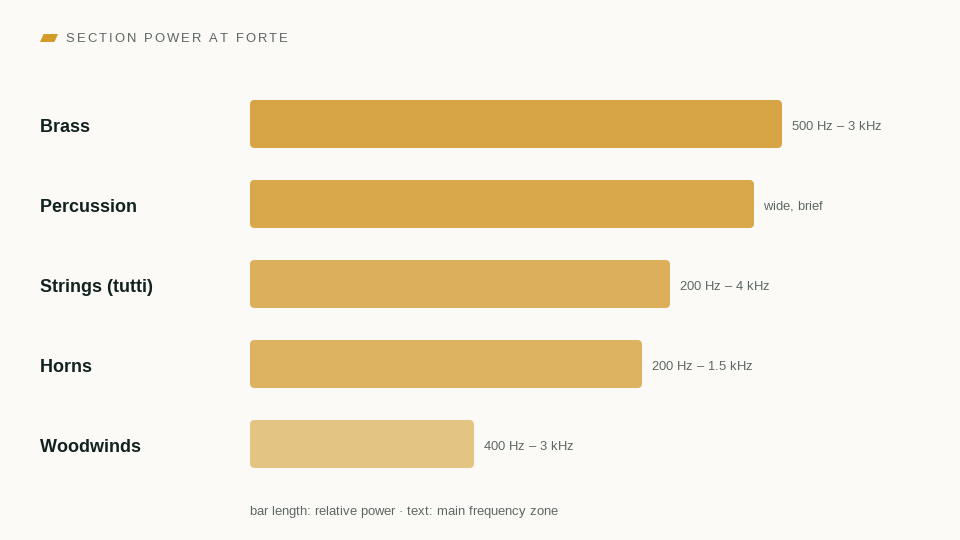
| Family | Power at forte | What masks it | What it masks |
|---|---|---|---|
| Strings (tutti) | loud, through numbers | brass at forte | woodwinds in the mids |
| Woodwinds | low to medium | almost everything | nothing, except in solo |
| Horns | loud, round | trumpets, trombones | violas, cellos |
| Trumpets, trombones | very loud | nothing | all the mids |
| Percussion | very loud, short | nothing | the others' attacks |
Step 1: balance starts with the writing
- Double the woodwinds when they play with the orchestra: flute and oboe in unison, or woodwinds doubled by a string section.
- Write the woodwinds in their right register: the flute shines up high, the oboe cuts through in the mids, the clarinet sounds full down low.
- Thin things out when a melody comes through: fewer brass, sustained strings, no percussion on the phrase.
- Brass at a softer dynamic: a brass piano often works better than a brass forte turned down with the fader, because the tone changes with the dynamic.
Step 2: work with family buses
Group the tracks into four buses: strings, woodwinds, brass, percussion. Set the overall balance between these four buses first, on a tutti passage. Only then balance the inside of each family (first violins against seconds, horns against trumpets).
- 1
Start with the strings
They're the foundation: set them so that a string tutti alone sounds right.
- 2
Add the brass
Bring them up until they support without covering the string melody. Push them back rather than turning them down.
- 3
Add the woodwinds
They should be heard in the passages given to them. If they disappear in the tutti, that's normal: it's the writing that has to leave them room.
- 4
Percussion last
It punctuates; too loud, it breaks the depth of the whole stage.
Step 3: balance in depth
A good balance isn't just a matter of levels. With brass and percussion further away and strings closer, the stage gets back the physical balance of a real orchestra, and the families mask each other less, because they don't arrive at the same moment or with the same color. The guide on mixing a virtual orchestra covers this layering in detail.
Step 4: the frequencies that fight
- 200 to 500 Hz: cellos, horns, trombones, low clarinets. It's the most crowded range; carve it slightly on the sections that don't have the lead role there.
- 1 to 3 kHz: trumpets, violins, oboes. That's where the brass cover the strings. A little less trumpet there gives room back to the violins.
- Above 8 kHz: the air of strings and cymbals. Attenuated on the back sections, it reinforces distance.
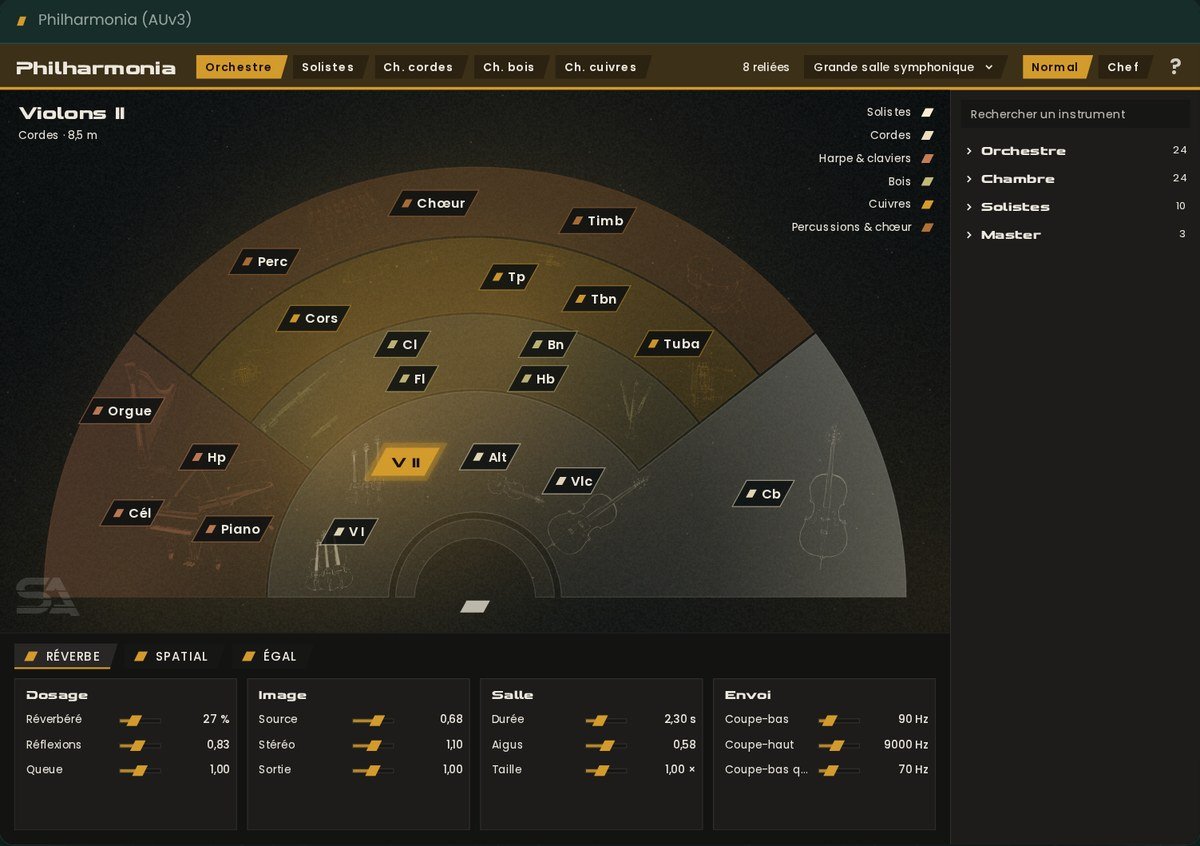
With Philharmonia: balance through placement
Philharmonia gives each section its place on the seating plan, in meters around the conductor. The distance EQ removes presence from distant sections, just like in a real hall. In Conductor mode, you see every instance in the project in its place and set them remotely, family by family.
Frequently asked questions
Why do the woodwinds disappear in my orchestra?
Because they're the weakest instruments in the orchestra. In the tutti, you need to double them or thin out the accompaniment when they play. Raising them with the fader makes them sound artificial.
How do you stop the brass from covering the strings?
Write them at a softer dynamic, push them back in the hall, and carve the trumpets slightly around 1 to 3 kHz. Lowering the fader alone keeps the harsh tone.
Should you use family buses?
Yes: four buses (strings, woodwinds, brass, percussion) let you set the overall balance in one move, before refining the inside of each family.
Velocity or volume to balance?
Velocity and expression first: they change the tone like a real player. Volume is for the final adjustment.
Updated on October 30, 2026.