Why percussion turns to mud
- Low end everywhere: every drum brings its low end, and the room extends all of it. The bottom of the spectrum overflows.
- A room that’s too long: on a fast ostinato, the tail of one hit covers the next.
- Drowned attacks: the reverb arrives together with the attack and softens it.
- Everything in the same place: every drum in the center, the image never opens up.
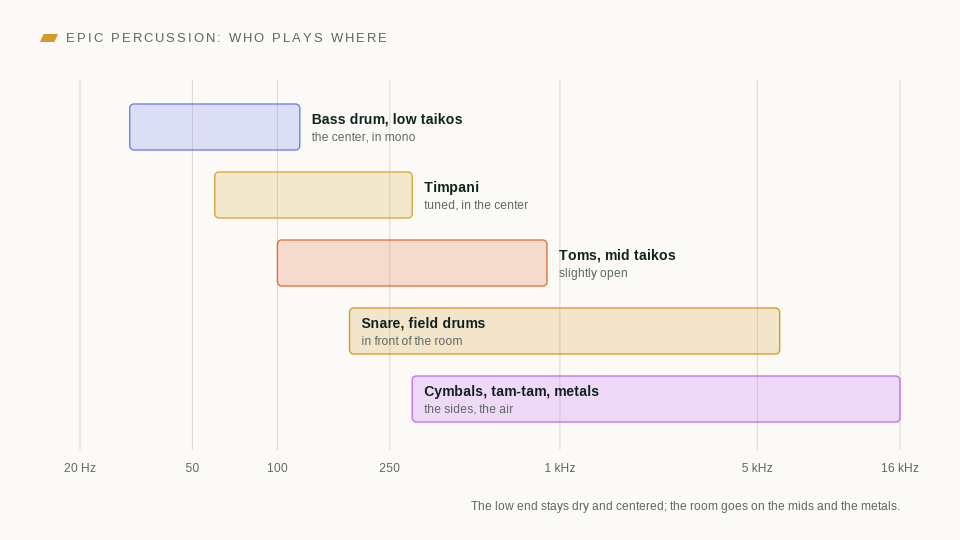
Each percussion instrument in its place
| Percussion | Position | Room |
|---|---|---|
| Bass drum, low taikos | center, mono | very little, low end cut |
| Timpani | center or slightly left | medium |
| Toms, mid taikos | spread on either side | medium |
| Snare, field drums | slightly off-center | early reflections, little tail |
| Cymbals, tam-tam, metals | the sides | wide, tail’s top end cut |
Step 1: a dry, centered low end
The low end of the percussion shouldn’t go into the room. Cut the reverb’s low end below 150 to 200 Hz, keep the bass drum and low taikos in the center, and keep only one instrument in charge of the sub range (often the bass drum): the other drums are gently filtered below 60 to 80 Hz.
Step 2: the attack before the room
A 20 to 40 ms pre-delay on the reverb lets the attack through before the room: the hit stays sharp, the room comes behind it. Short drums (snare, field drums) get more early reflections and less tail.
Step 3: a wide, short room
For an ostinato at 120 BPM, a sixteenth note lasts 125 ms: a 3-second tail covers dozens of hits. Choose a wide room (for size) but a short one (1.2 to 1.8 s) that stops before drowning everything. Save long tails for isolated hits.
Step 4: compress without squashing
On the percussion bus: a slow attack (20 to 40 ms) to let the hit through, a release locked to the tempo, 3 to 6 dB of reduction. You hold the level of the hits without squashing their body. A compressor that’s too fast flattens the attacks and makes the drums sound like cardboard.
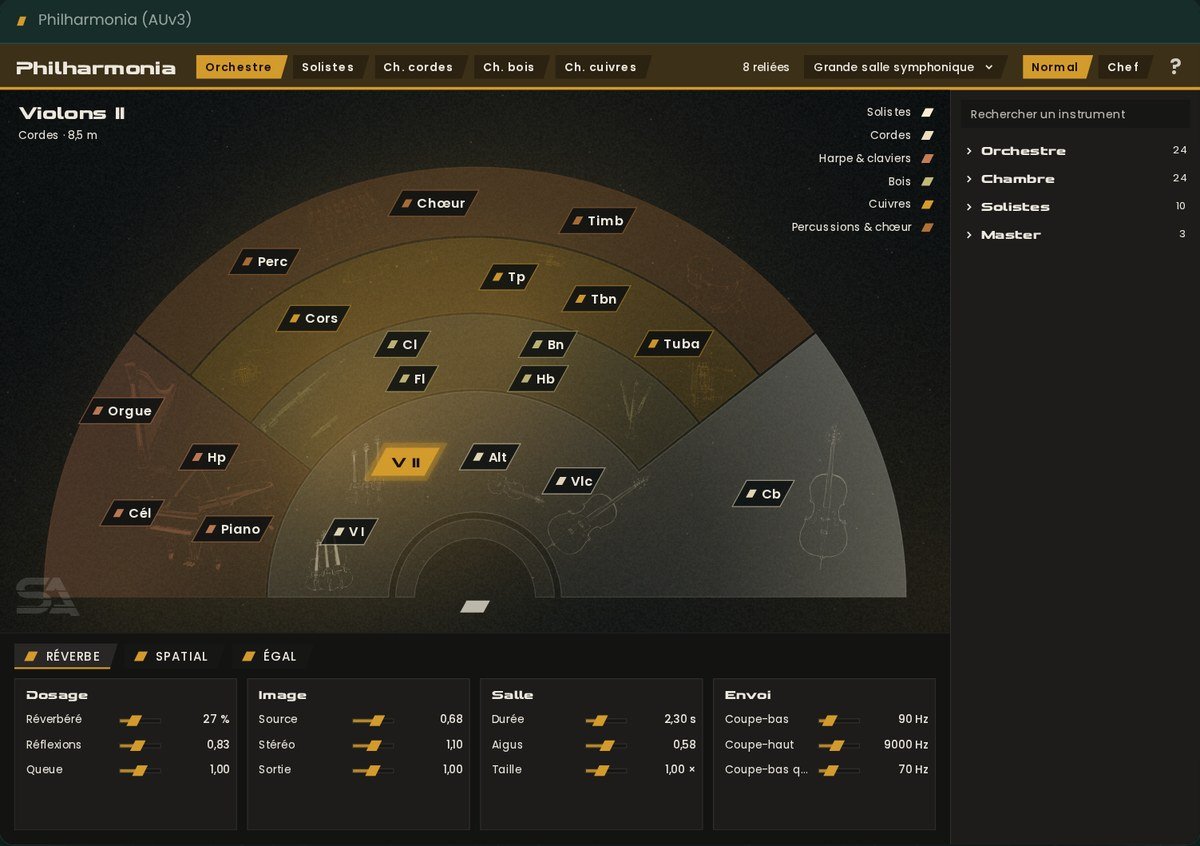
Philharmonia’s Drums stage
Philharmonia has a Drums stage with fourteen drums and a tutti, each in its real place on stage. The fundamentals keep the center, the higher drums and the metals open up the image; the pre-delay grows with distance so the attack comes before the room. Four modes set everything together:
- Epic (default): heavy, dry low end, attack up front, compression that holds the drums without spreading their body, a wide and short room.
- Trailer: huge and dark, an enlarged big hall, a long tail behind the drums, a very wide image; the low end stays dry.
- Scoring: a large scoring stage, close, tight, clean.
- Orchestral: realistic, the orchestral percussion in a big hall, but readable.
| Setting | Value | Why |
|---|---|---|
| Drums mode | Epic (ostinato) or Trailer (isolated hits) | The room follows the percussion’s role |
| Comp: Attack | slow | The attacks get through |
| Reverb: Tail low cut | high | The low end stays dry |
| Position of the low drums | center | The weight in the middle |
Frequently asked questions
How do I make taikos more powerful in the mix?
Keep their low end dry and centered, let the attack through before the reverb (20 to 40 ms pre-delay) and compress with a slow attack. Power comes from the attack and a clean low end, not from the reverb.
Which reverb for epic percussion?
A wide but short room (1.2 to 1.8 s) for an ostinato, longer for isolated hits. Always cut the reverb’s low end.
Should percussion be panned wide?
Low drums in the center, toms slightly spread, metals and cymbals on the sides. A wide image that keeps a solid center.
Why does my percussion cover the orchestra?
Often because of the combined low end of all the drums and a room that’s too long. Filter the secondary drums below 60 to 80 Hz and shorten the tail.
Updated on November 23, 2026.