Which level should you aim for?
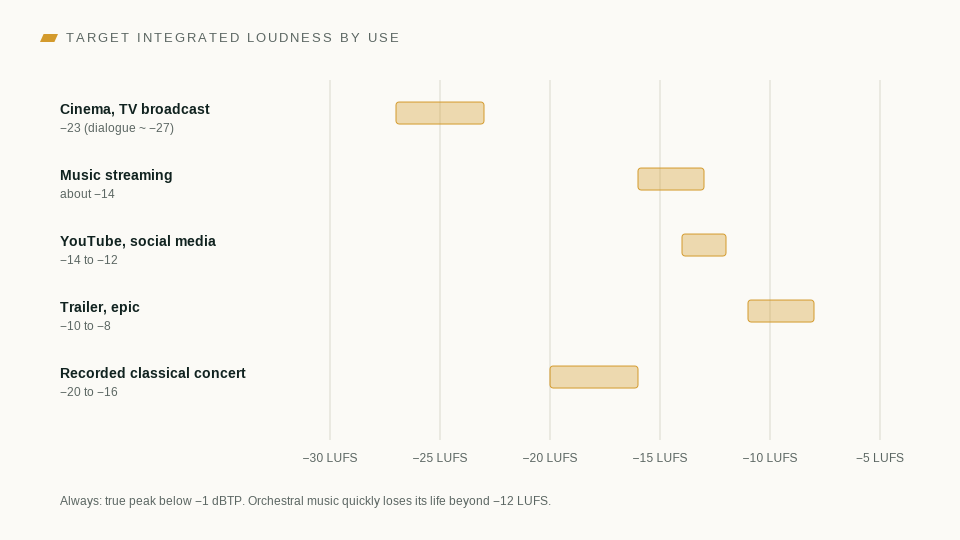
Loudness is measured in integrated LUFS (the average loudness over the whole track), not in peak level. Streaming platforms turn tracks that are too loud down to their reference level: an orchestra mastered at −8 LUFS will be turned down, having lost its dynamics for nothing.
True peak: the real peak
A file can never exceed 0 dBFS sample by sample and still clip once converted (to MP3, AAC, or by a speaker’s converter). The true peak measurement (dBTP) detects these peaks “between the samples”. Keep it below −1 dBTP, −2 if the file will be heavily compressed.
The method, in order
- 1
Measure the loudest passage
Find the most powerful tutti. It decides the ceiling, not the average.
- 2
EQ very little
A slight dip around 250 to 400 Hz if the tutti is muddy, a little air above 10 kHz. Corrections of 1 to 2 dB, no more.
- 3
Compress barely (or not at all)
A slow, low-ratio compressor (1.5:1) can slightly bring the extremes closer. If the music must be heard in a noisy environment, prefer volume automation on the pianissimo passages.
- 4
Limit gently
Ceiling at −1 dBTP, 1 to 3 dB of reduction on the tutti peaks. If the limiter works harder, lower the input gain.
- 5
Check the integrated loudness
Compare it with the target for the use. Too low: raise the gain, not the compression.
The Conductor’s Master in Philharmonia
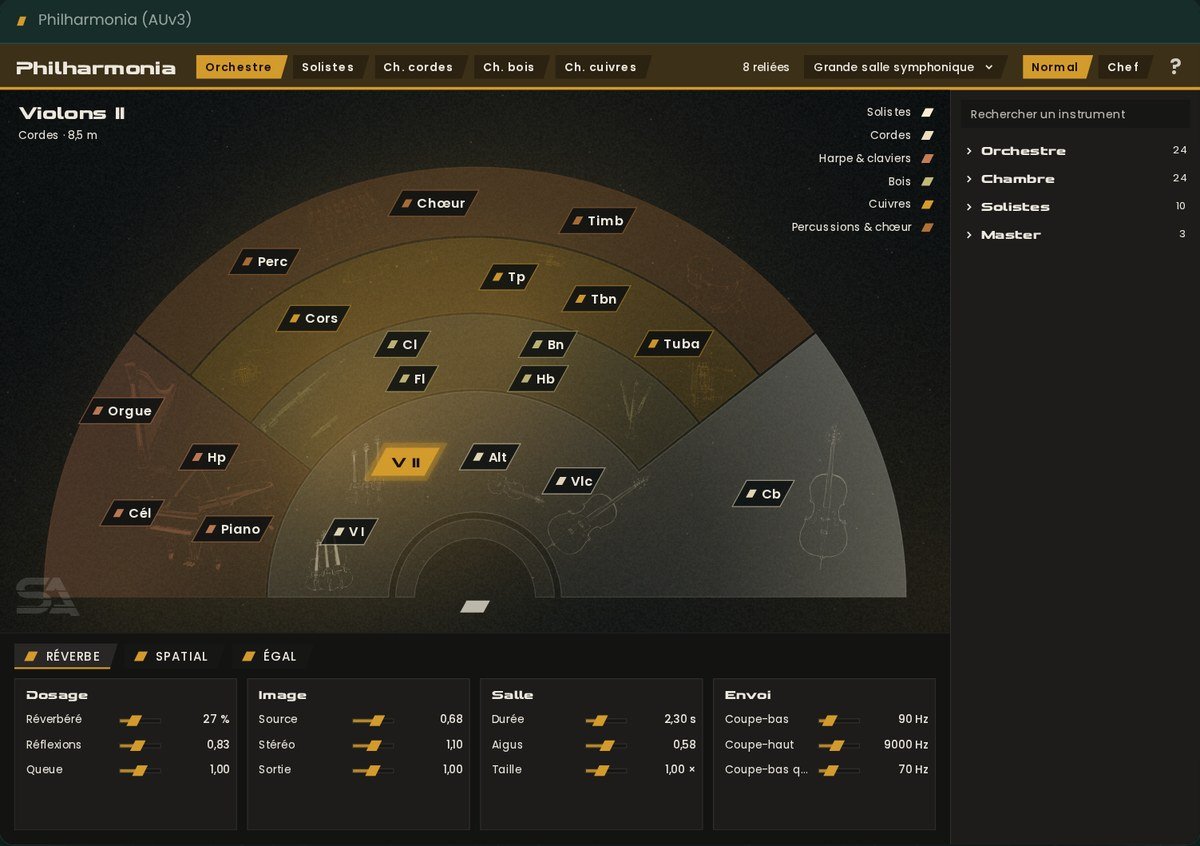
In Philharmonia, the Conductor instance sees the whole orchestra and carries the Master, on the bottom bar. Contour sets the shared veil of the room; the Maximizer (Threshold; the ▲ arrow opens the true peak ceiling, the dynamics and the release) holds the peaks; the Loudness meter shows the short-term loudness, the integrated loudness (I), the true peak (TP) and the maximizer’s gain reduction.
| Setting | Value | Why |
|---|---|---|
| True peak ceiling | −1 dBTP | No clipping after conversion |
| Maximizer: reduction | 1 to 3 dB on the tutti | The dynamics remain |
| Integrated loudness | −16 to −14 LUFS | The platforms’ level |
| Contour | light | A shared room, without a veil |
Frequently asked questions
What LUFS level for film music?
For cinema and TV, you often aim for −23 LUFS integrated (the EBU R128 standard in Europe), or deliver stems to the mixer. For a trailer meant for the web, −10 to −8 LUFS is common.
Should orchestral music be compressed?
Very little. Dynamics are part of the writing. Prefer light volume automation and a limiter that only works on the tutti peaks.
What is true peak?
The real peak of the signal once converted back to analog or to a compressed format. It can exceed the sample peak; keep it below −1 dBTP.
Why does my orchestra sound quieter than pop on Spotify?
Because platforms bring everything to the same integrated level: heavily compressed pop sounds loud all the time, an orchestra keeps its quiet passages. That’s normal, and it’s what makes its tutti impressive.
Updated on November 23, 2026.