Why a virtual choir sounds wrong
Choir libraries are recorded by real singers. What sounds wrong, almost always, is the writing: notes no singer would hold at that pitch, impossible leaps, a single vowel over three minutes. The ear knows the human voice very well and spots these mistakes immediately.
- Out of range: a tenor written too high sounds strained, a bass too low turns into a growl.
- Block chords: each voice jumps from one chord to the next instead of singing a line.
- A frozen vowel: the tone never changes, the choir turns into a synth pad.
- Detached notes: each note re-attacks, while a choir connects its phrases.
Step 1: the ranges of the four sections
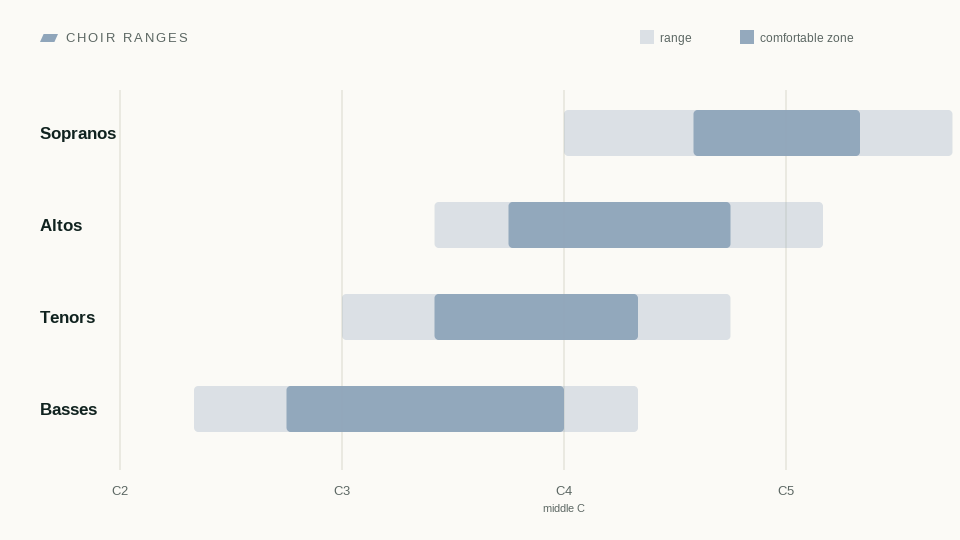
A mixed choir is split into four sections. Each one has a zone where it sounds good, and extremes to avoid or save for the peaks.
| Section | Range | Comfortable zone | Character |
|---|---|---|---|
| Sopranos | C4 – A5 | G4 – E5 | Luminous, piercing up high |
| Altos | F3 – D5 | A3 – A4 | Warm, the heart of the choir |
| Tenors | C3 – A4 | F3 – E4 | Tense and bright up high |
| Basses | E2 – E4 | A2 – C4 | Deep, the foundation |
Step 2: voice leading
Writing for choir means writing four melodies that sound together, not a series of chords. The classic voice-leading rules are exactly what makes a choir sound real.
- 1
Keep common tones
If two chords share a note, the voice singing it keeps it.
- 2
Move by small intervals
The inner voices (altos, tenors) move mostly by step. Big leaps are for the bass and for expressive moments.
- 3
Avoid crossings
Altos stay below the sopranos, tenors below the altos. A crossing blurs the lines.
- 4
Wide intervals in the low end, close voices up high
Wide intervals go in the low end (bass and tenor a fifth or an octave apart), the high voices can be close. A third between basses and tenors in the low end sounds muddy.
Step 3: bring the vowels to life
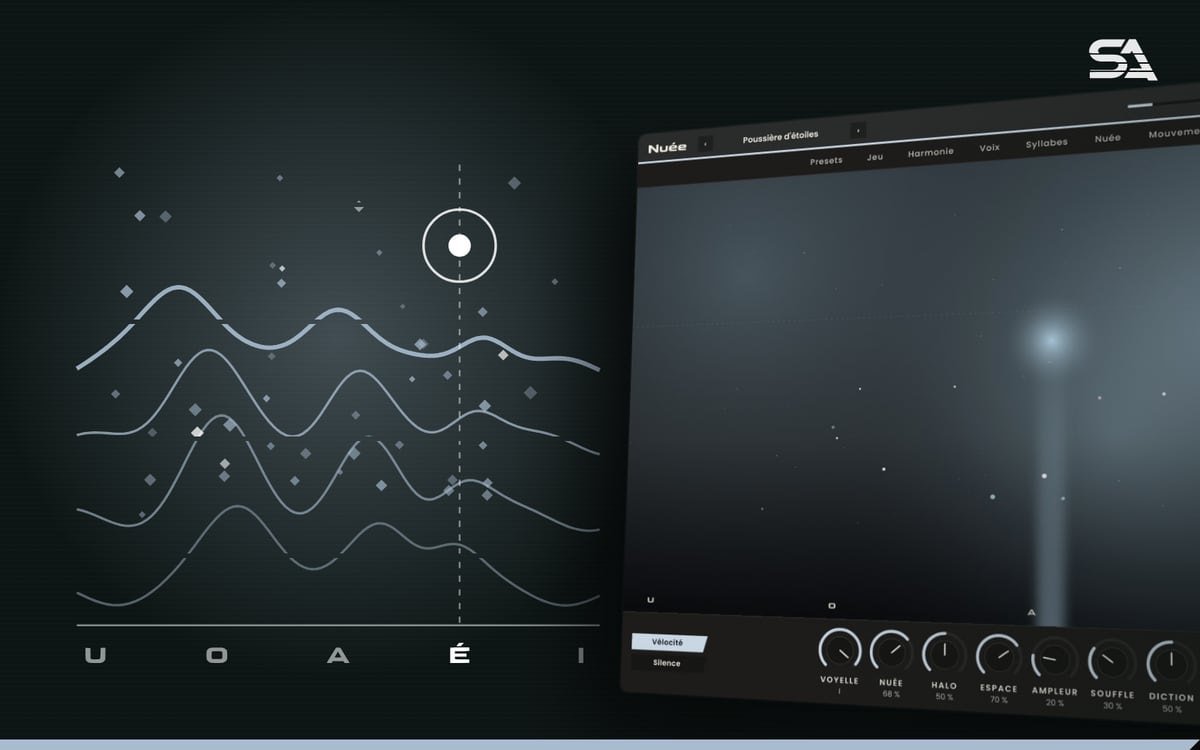
The vowel is the choir's tone. Dark vowels (U, O) are deep, intimate, mysterious; bright ones (E, I) shine and cut through; A is open and powerful. Changing vowels as the phrase goes on is the most effective move to make a choir breathe.
- Open up with the music: going from U to A during a crescendo gives the feeling that the choir is opening up.
- Close to conclude: coming back to O or U at the end of a phrase calms things down.
- For real lyrics, see making a virtual choir sing words.
Step 4: connect the phrases and breathe
A choir sings legato: the notes of a phrase follow each other without a break, gliding slightly. Overlap the MIDI notes by a few milliseconds to trigger your library's legato, and leave a real silence for breaths, between phrases. A choir that never breathes isn't human.
Step 5: dynamics
Velocity sets the note's attack, but the dynamics of a held note are set continuously, with expression (CC11) or the mod wheel (CC1). A choir holding a chord without the slightest crescendo or decrescendo sounds mechanical. Draw arches: each phrase swells slightly toward its peak and falls back.
With Nuée: the dreaming choir
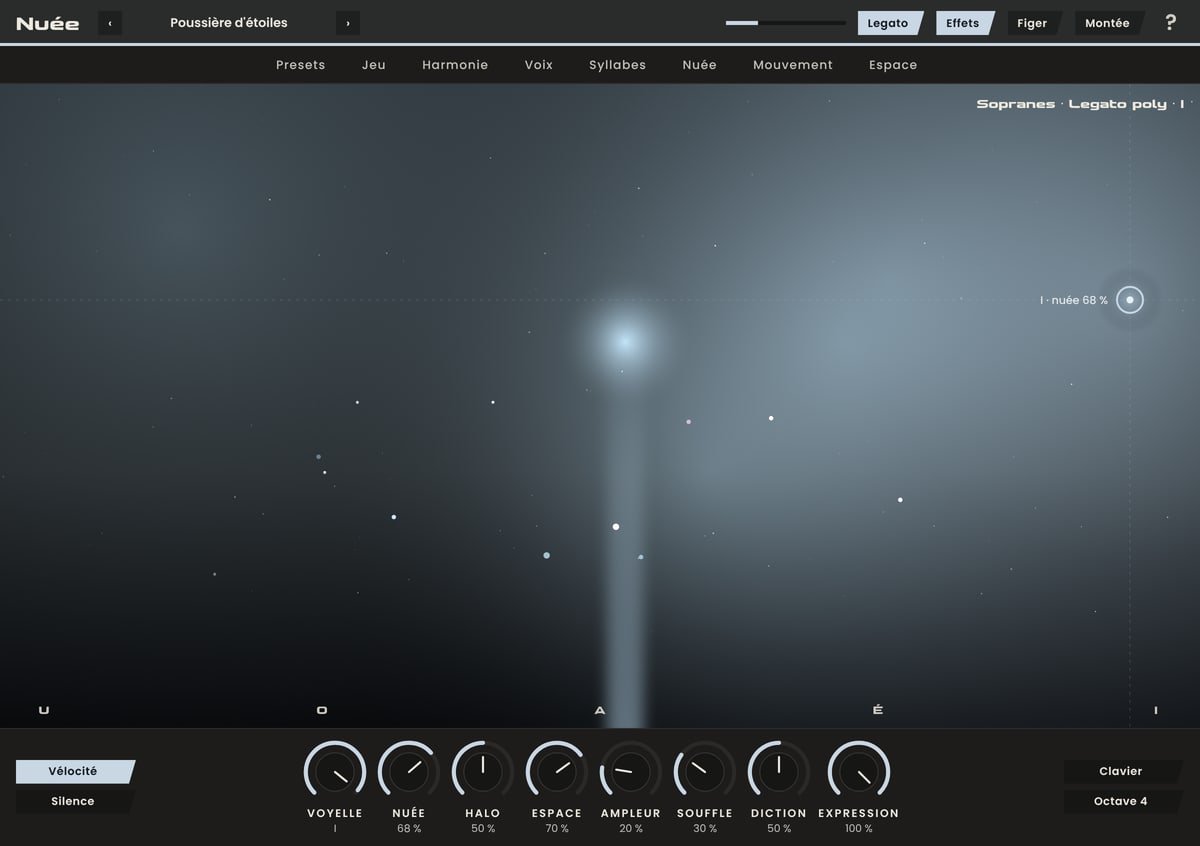
Nuée doesn't aim for realism: it's a dreamlike choir, designed for film music and ambiences. But it applies the same principles, in its own way.
- The scene: from left to right, the cursor glides the vowel from U to O, A, E, I; from bottom to top, it sets the amount of grain cloud. Changing vowel means moving the cursor.
- The sections: sopranos, altos, tenors, basses or tutti, with the number of voices per note, from a single voice to a large choir.
- Four-voice chords: one key makes a complete chord sing (sopranos, altos, tenors, basses), chosen by the key or fixed.
- Legato: overlapping notes glide into each other; velocity sets the glide speed. In poly mode, each voice of a chord glides to the nearest note: voice leading, automatic.
- Expression: volume, brightness and vibrato at once, with the mod wheel or CC11.
Frequently asked questions
What is the range of an SATB choir?
As usual guidelines: sopranos C4 to A5, altos F3 to D5, tenors C3 to A4, basses E2 to E4 (C4 = middle C on the piano). Each section's comfortable zone is narrower by about a third on each side.
How do you make a MIDI choir less robotic?
Write singable lines, overlap the notes for legato, leave breaths, change vowels with the music and draw the dynamics with expression (CC11) or the mod wheel.
Which vowel should you choose for a film choir?
O or U for mystery and intimacy, A for power, E or I for light. The most effective is to move from one to another as the phrase goes on.
How many voices per section?
A single voice for intimacy, four to eight for a chamber choir, more for a large film choir. More voices means more breadth but less diction.
Updated on October 7, 2026.