Where does a choir sit?
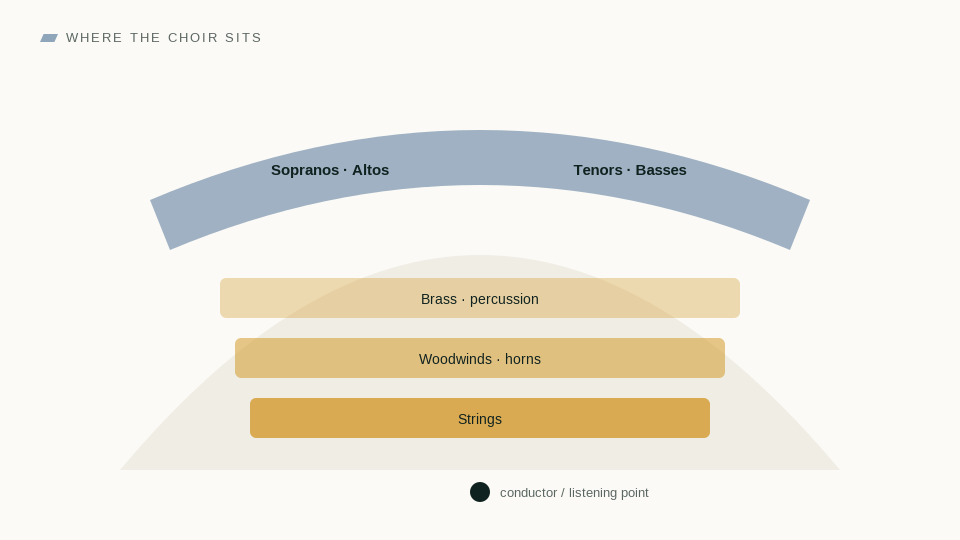
On a concert stage, the choir is behind the orchestra, raised, often across the full width. In the mix, that means: wide, distant (wetter than the strings), and slightly darker than the front-row instruments.
Step 1: EQ
| Zone | Frequencies | Move |
|---|---|---|
| Useless low end | below 80 to 100 Hz | Low cut (except very low basses) |
| Muddy mids | 250 to 400 Hz | Remove 2 to 4 dB if the choir sounds thick |
| Nasality | 800 Hz to 1.2 kHz | Remove a little if the voices sound "boxy" |
| Presence | 2 to 4 kHz | Careful: that's also where the violins are |
| Sibilants | 5 to 8 kHz | Soften (de-esser) if the S and T sounds hiss |
| Air | 10 to 14 kHz | A slight boost for a celestial choir |
Step 2: width
If your sections are on separate tracks, place them as on stage: sopranos and altos on one side, tenors and basses on the other, or each section spread across the full width for an enveloping choir. Keep the basses closer to the center: wide low end makes the mix blurry.
Step 3: the room
The choir must be in the same hall as the orchestra, but further back: a little more wet signal, weaker Early reflections, slightly reduced highs. For the depth method, see how to mix a virtual orchestra and Reverb settings for orchestra.
A choir alone, without an orchestra, can take a longer room (4 to 8 s).
| Setting | Choir | For comparison: strings |
|---|---|---|
| Hall length | 2 to 3 s (same hall) | 2 to 3 s |
| Wet amount | higher | medium |
| Pre-delay | short (0 to 15 ms) | 15 to 30 ms |
| Reverb highs | reduced | natural |
Step 4: level against the orchestra
- The choir carries the lyrics or the melody: it comes forward, the orchestra tightens around it (fewer brass, softer strings).
- The choir is a color: it stays behind, at the level of a horn section.
- Tutti: forte brass always cover a choir. Double the choir's melody in the horns, or have the choir sing an octave above the brass.
- Dynamics: a gentle compressor (2:1, 2 to 3 dB of reduction) helps the choir stay present without crushing its dynamics.
With Nuée: preparing the choir for the mix
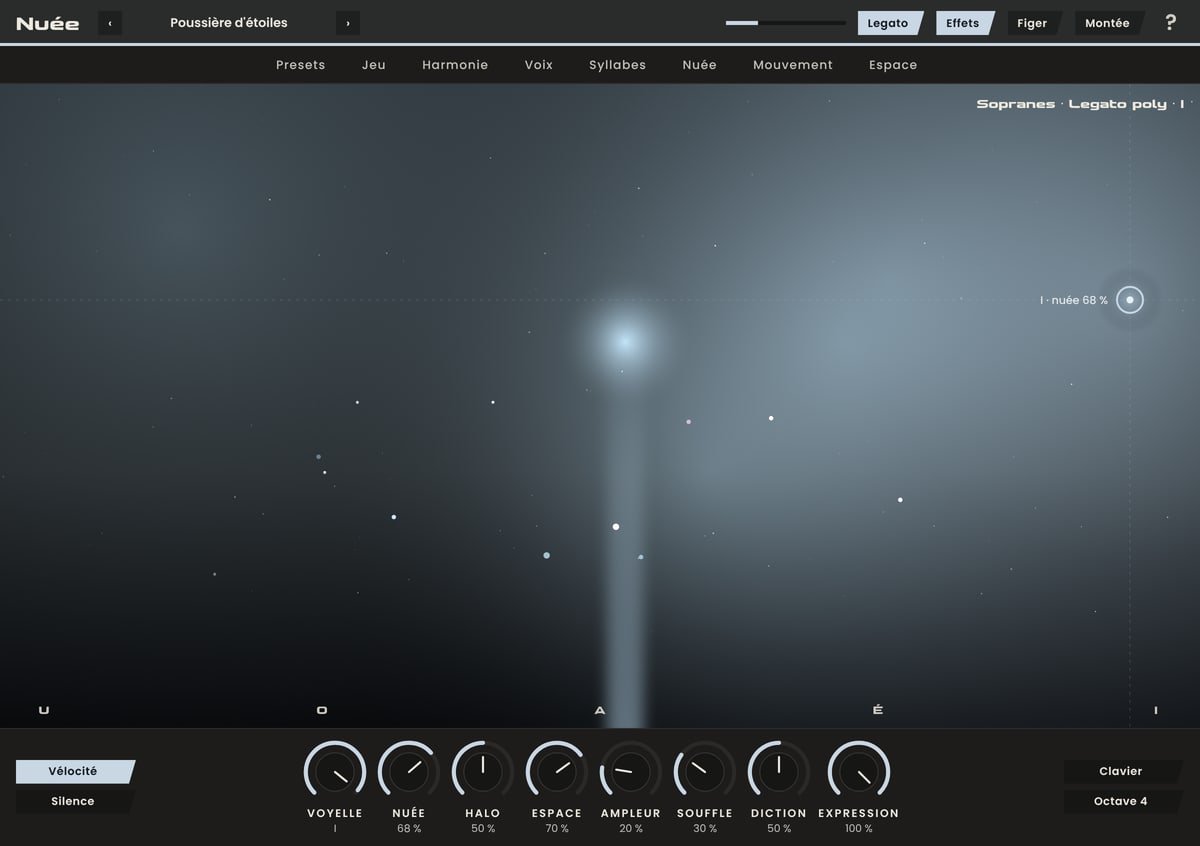
Nuée has its own room (from 2.5 to 12 seconds) and its own effects, designed for a dream choir. In an orchestral mix, there are two ways to go:
- Keep Nuée's room for textures and distant choirs: it's part of the sound. Lower Space if the choir has to join the orchestra up front.
- Go through the project's room: the FX button cuts cloud, halo, room and fullness all at once. The choir comes out dry and goes through the same Reverb as the orchestra, for example Philharmonia, which will place it at the back of the stage.
The Diction control pushes the effects behind the syllables: useful when the choir has to be understood over the orchestra. For the writing, see writing for a virtual choir.
Frequently asked questions
What EQ for a choir?
A low cut around 80 to 100 Hz, 2 to 4 dB less around 250 to 400 Hz if the sound is thick, a de-esser around 5 to 8 kHz, and possibly a little air around 12 kHz.
Should the choir have more Reverb than the orchestra?
A little more wet signal, in the same hall: it sits further back, at the back of the stage. A different hall would make it sound like a separate layer.
How do you get a choir above the brass?
Lighten the orchestra during the sung passages, have the choir sing above the brass register, or double its melody in the horns. Raising the choir alone is almost never enough.
Should you compress a choir?
Lightly: a 2:1 ratio and 2 to 3 dB of reduction stabilize it without crushing the dynamics that give it life.
Updated on October 30, 2026.